Last updated 2026-08-17
TL;DR
Arizona requires a license to work as a court reporter, and that includes digital reporters. The Arizona Supreme Court runs the Certified Reporter program. Budget $50 to $200 for the application, plan for a fingerprint background check, and pass a state-recognized certification exam. Most people finish the whole process in one to six months, depending mostly on how long exam prep takes.
Do you need a license to work as a digital court reporter in Arizona?
Yes. Arizona requires anyone who reports official court proceedings to hold a Certified Reporter (CR) license issued under the authority of the Arizona Supreme Court. That applies whether you use a stenotype machine, a voice writer, or digital audio recording gear. There is no separate "digital only" license category, which trips up a lot of people coming in from other states.
The licensure framework sits under the Arizona Code of Judicial Administration (ACJA) Section 7-206. [1] The Arizona Supreme Court's Court Reporting Program office handles applications, renewals, and complaints.
Work solely as a scopist, transcriptionist, or audio technician and never personally certify a transcript, and you may fall outside the CR requirement. The moment your name goes on a certified transcript, you need the license. Confirm that line with the Arizona Supreme Court office before you assume you're clear of it.
What law governs digital court reporters in Arizona?
The primary document is the Arizona Code of Judicial Administration, Section 7-206, titled "Court Reporting." [1] It defines who qualifies as a court reporter, which certifications the Supreme Court accepts, what continuing education reporters complete, and how the CR license renews. The Supreme Court updates this section from time to time, so read the current version on the Arizona Judicial Branch site, not a cached copy floating around a forum.
Section 7-206 gives the Supreme Court discretion to approve or drop specific exams over time. That flexibility is exactly why you verify the approved exam list at the source instead of trusting a two-year-old article.
For digital court reporters, the approved pathway usually runs through the American Association of Electronic Reporters and Transcribers (AAERT) Certified Electronic Reporter (CER) or Certified Electronic Transcriber (CET) credentials, or through the National Court Reporters Association's (NCRA) Registered Professional Reporter (RPR) exam. Check the current approved list directly with the Arizona Supreme Court. Approvals change. [2]
What are the eligibility requirements for an Arizona CR license?
Arizona's eligibility requirements under ACJA Section 7-206 generally include: [1]
- Be at least 18 years old
- Hold a high school diploma or equivalent
- Pass a state-approved court reporting certification exam
- Pass a criminal background check
- Submit a completed application with the required fee
There's no Arizona-specific residency requirement, so you can hold the license while living out of state. Confirm that with the court program office, since operational rules shift. Arizona also doesn't require a set number of in-classroom training hours at the licensure stage, unlike some states. The exam is the competency gate.
The background check matters more than people expect. A prior felony doesn't automatically disqualify you, but the Supreme Court reviews each case on its own. If you have anything in your history, file early and disclose it proactively with documentation of rehabilitation. A surprise denial costs you months.
Already hold a valid CR license in another state? Arizona has a reciprocity provision. You still apply and pay the fee, but you may skip the exam if your home state's credential is recognized. [1] Verify the current list of recognized states before you count on it.
How much does a digital court reporter license cost in Arizona?
Arizona's court reporter license fees are set by the Arizona Supreme Court and have historically run $50 to $200 for an initial application. [3] The renewal fee sits in a similar range. Neither number is locked in statute at a fixed dollar amount, so treat any figure you read online, this one included, as a starting estimate. Confirm the current fee schedule with the Court Reporting Program office before you submit.
Beyond the state fee, the real all-in cost looks like this:
| Cost item | Estimated range | Notes |
|---|---|---|
| AZ CR application fee | $50, $200 | Confirm with AZ Supreme Court |
| Fingerprint / background check | $20, $75 | Fee varies by provider |
| AAERT CER exam | $100, $150 | Per AAERT published fee schedule [2] |
| NCRA RPR exam (alternative) | ~$250 | Per NCRA fee schedule [4] |
| Equipment (recorder, software) | $300, $2,000+ | Wide range depending on setup |
| Prep course or study materials | $0, $500 | Optional but most people use something |
The exam fee is the one cost that's genuinely fixed and publicly posted. AAERT lists its CER fee on its site; NCRA lists the RPR fee on its testing page. [4] Everything else, application and background check fees included, gets verified at the source.
Skip the premium prep courses until you've worked through the free AAERT study materials. Plenty of candidates pass the CER on self-study. Those $300-to-$500 prep packages are not magic.
How long does it take to become a licensed digital court reporter in Arizona?
The total timeline splits into three phases, and they don't always run in parallel.
Phase one is exam prep. Coming in with no transcription or audio recording experience, most people need six weeks to four months of focused study to pass the AAERT CER exam. Already work in audio or video production, or medical transcription? A few weeks may do it.
Phase two is the exam. AAERT offers the CER as a remote proctored exam, so you're not waiting for a regional test date. You schedule it when you feel ready. [2] The NCRA RPR runs at testing centers on a scheduled basis, which adds wait time.
Phase three is Arizona application processing. The Court Reporting Program processes applications on a timeline that moves with their current volume. People have reported four to eight weeks, but that's anecdotal, and the office doesn't publish a guaranteed window. A complete application with every document and fee moves faster than an incomplete one.
Realistic total: one to six months from the day you decide to pursue licensure to the day you hold the CR license. Three months is a fair planning assumption for someone organized with some relevant background.
The fingerprint processing is the invisible bottleneck. Arizona uses the DPS-managed fingerprint clearance process, which can take two to eight weeks depending on volume. [5] Submit that before or alongside your application, not after.
What exam do digital reporters take to qualify for the Arizona CR license?
Arizona accepts certification exams approved by the Director of the Supreme Court's Court Reporting Program. The AAERT Certified Electronic Reporter (CER) exam is the most common pathway for digital court reporters. [2] The NCRA Registered Professional Reporter (RPR) exam is also recognized, and it's the traditional stenography credential.
The AAERT CER tests your ability to run electronic recording equipment, monitor audio quality during a proceeding, and produce or supervise an accurate transcript. It's multiple-choice, delivered remotely. The passing score is 70 percent. [2] There's no words-per-minute speed test, which is a real difference from the RPR.
The NCRA RPR includes speed tests at 225 words per minute and above. It's harder to pass but more universally recognized if you ever want to work in stricter states. Plan to stay in Arizona and work primarily in digital, and the CER is the faster, cheaper route.
Here's what nobody tells you clearly: passing the CER gets you exam eligibility. It does not issue the Arizona license. You still submit the Arizona application separately. Two processes, two fees.
How do you apply for an Arizona CR license step by step?
Here's the actual sequence:
1. Pass your approved certification exam (AAERT CER or equivalent) and get your certificate or score letter. 2. Get fingerprinted through an Arizona DPS-approved livescan provider and start the background check. [5] Do this early. It takes the longest. 3. Access the current CR application from the Court Reporting Program page on the Arizona Judicial Branch website. [3] 4. Complete the application, attach your exam certificate, attach proof of your high school diploma or equivalent, and include the application fee. 5. Submit everything to the Court Reporting Program office. The instructions specify mail or online. Confirm the current submission method with the office, because it has changed before. 6. Wait for the background check clearance to come through and be matched to your application file. 7. Once approved, the Supreme Court issues your CR certificate.
The most common mistake is submitting the application before the background check clears, then emailing the office every two weeks for a status update. The office can't issue the license until every piece is in the file. Submit everything you control right away, then let the fingerprint process run.
Want a paper trail of what Arizona expects at each step? The Digital Court Reporter Path Kit at DigitalReporterPath covers that document checklist for Arizona and other states. You can also build the list yourself from the ACJA Section 7-206 language and the official application instructions.
Does Arizona have reciprocity with other state CR licenses?
Arizona's ACJA Section 7-206 includes a reciprocity provision for applicants who already hold a valid court reporter license in another state. [1] If your home state credential was issued on an exam Arizona also recognizes, you may qualify to apply without re-testing.
Reciprocity isn't automatic and it isn't a guarantee. You still file an application, pay the fee, pass a background check, and provide documentation of your existing license in good standing. What reciprocity waives, in most cases, is the exam.
The list of states whose credentials Arizona recognizes can change, and the Court Reporting Program office is the only authoritative source for it. Don't rely on a forum post or an article, this one included, for that confirmation.
Coming from California, Colorado, or Arkansas? The underlying credential requirements vary enough that you need to check Arizona's current reciprocity list rather than assume.
One practical note: even under reciprocity, your existing license must be in good standing and free of any disciplinary action. A suspended license in State A does not transfer cleanly to Arizona.
What continuing education does Arizona require to renew the CR license?
Arizona requires Certified Reporters to complete continuing education (CE) to renew. Under ACJA Section 7-206, the CE requirement is currently 10 hours per renewal period. [1] The renewal period is two years. At least some of those hours must cover ethics, though confirm the exact breakout in the current version of Section 7-206, since the Supreme Court has authority to adjust CE.
Approved CE providers include NCRA, AAERT, and other organizations the Supreme Court recognizes. Online CE is generally accepted. Cost varies: AAERT often runs webinars in the $0 to $50 range per hour of credit; NCRA offerings range wider.
The renewal fee is separate from the CE cost. Confirm the current renewal fee with the Court Reporting Program office at renewal time.
Missing the deadline hurts. Arizona can suspend or revoke your CR status for failure to renew, and reinstatement means more paperwork and fees. Set a calendar reminder 90 days before your renewal date so you have time to finish CE if you haven't already.
How does Arizona compare to neighboring states for digital court reporter licensing?
Arizona sits in the middle of the pack for licensing difficulty among its neighbors.
| State | License required? | Dedicated digital pathway? | Reciprocity? |
|---|---|---|---|
| Arizona | Yes (CR license) | No separate category; CR covers digital | Yes, with approved states [1] |
| California | Yes (CSR license) | No; CSR covers all methods | Limited [6] |
| Colorado | Yes | No separate category | Yes [7] |
| Nevada | Yes | No separate category | Yes |
| New Mexico | No statewide license | N/A | N/A |
| Utah | No statewide license | N/A | N/A |
New Mexico and Utah not requiring a statewide license is worth knowing if you're deciding where to plant your freelance operation. Arizona's requirement is real, but the exam barrier (the CER rather than a speed-based steno test) is lower than California's CSR exam, which has a high failure rate. [6]
Comparing to Alabama or Alaska? The regulatory structures differ enough that reading each state guide beats a direct comparison.
Arizona's two-year renewal with 10 CE hours is manageable. California requires 24 hours per two-year period for CSR holders. [6] That gap adds up in time and money over a career.
What equipment do digital court reporters use in Arizona proceedings?
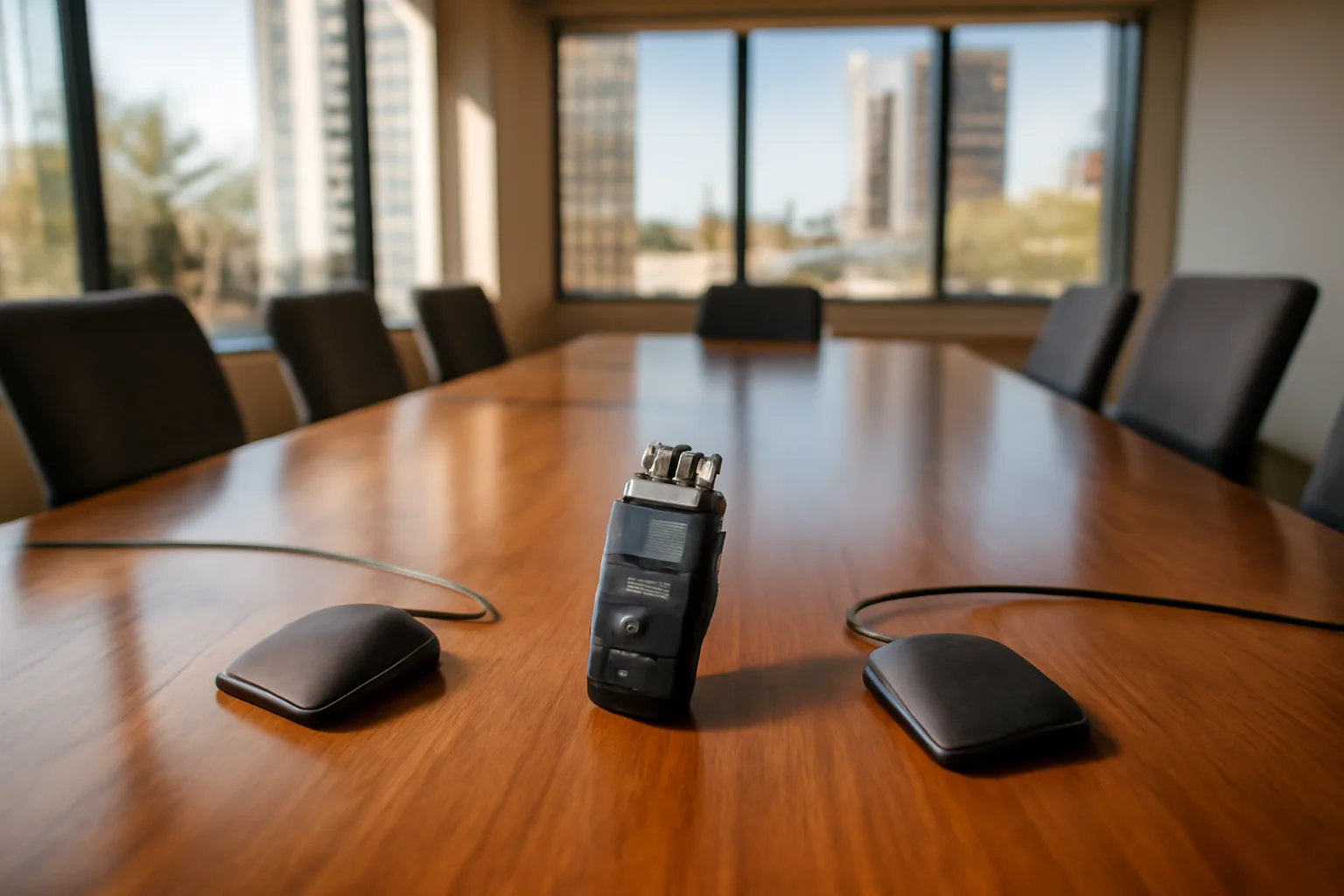
Arizona courts don't mandate a specific brand or model of recording gear. What matters is that the equipment produces a clear, accurate, archivable audio record. In practice, most digital reporters in Arizona use a dedicated multi-track digital audio recorder (Olympus, Marantz, or FTR are common), paired with directional or boundary microphones set around the conference table or courtroom.
FTR (For the Record) software shows up in courtrooms where the court supplies the recording system. Freelance for a reporting firm and you typically bring your own equipment, sometimes working with software like Stenograph's Case CATalyst, Eclipse, or standalone editors like Audacity for transcript sync.
A realistic entry setup runs $500 to $2,000, as the cost table above shows. Resist the $50 USB recorder. Audio quality problems turn into transcript certification problems, and that's a professional liability issue, more than an annoyance.
For a deeper look at setting up your first year, the how to start digital court reporter in Arizona guide covers equipment selection, firm relationships, and rate-setting.
Where do you find official Arizona CR license information?
The Arizona Judicial Branch website is the primary source. The Court Reporting Program page sits under the Administrative Office of the Courts and hosts the current application, fee schedule, approved exam list, and ACJA Section 7-206 in full. [3]
Don't rely on third-party licensing prep companies, forums, or state comparison databases for specific fee amounts or the current approved exam list. Those go stale fast, and the Arizona Supreme Court doesn't always send public notices when it changes a fee or adds an exam.
For the exam side, go straight to AAERT's website for the CER application and current fee, and NCRA's site for RPR information. [2][4] For background checks, the Arizona Department of Public Safety runs the fingerprint clearance card process. [5]
Want one place to organize all this paperwork and see how the pieces connect across states? DigitalReporterPath's resource library at /start covers the document paths for Arizona and other states. The official sources above are what the board actually checks against, so those stay your verification layer.
Frequently asked questions
Do you need a license for digital court reporter in Arizona?
Yes. Arizona requires a Certified Reporter (CR) license issued by the Arizona Supreme Court for anyone who certifies a transcript of a legal proceeding. This applies to digital reporters just as it does to stenographers or voice writers. There is no separate digital-only license; the CR credential covers all reporting methods. The requirement is in Arizona Code of Judicial Administration Section 7-206.
How much does it cost to get a digital court reporter license in Arizona?
The state application fee has historically been in the $50 to $200 range, but confirm the current fee with the Arizona Supreme Court before applying. Add $20 to $75 for fingerprinting, $100 to $150 for the AAERT CER exam, and potentially $300 to $2,000 for equipment. Total out-of-pocket to get licensed and operational commonly runs $600 to $2,500 depending on your equipment starting point.
How long does it take to become a digital court reporter in Arizona?
Plan for one to six months total. Exam preparation takes most people four to twelve weeks. The AAERT CER exam is remotely proctored so there's no long wait for a test date. Arizona Supreme Court application processing typically takes four to eight weeks anecdotally, though no official processing window is published. The fingerprint background check is often the longest single delay, running two to eight weeks through Arizona DPS.
What exam do I take to become a Certified Reporter in Arizona?
The AAERT Certified Electronic Reporter (CER) exam is the most common pathway for digital court reporters in Arizona. The NCRA Registered Professional Reporter (RPR) exam is also accepted. The CER is a multiple-choice remote exam with a 70 percent passing threshold and no speed component. The RPR includes speed tests and is harder to pass but more broadly recognized nationally. Check the Arizona Supreme Court's current approved exam list before registering.
Can I get an Arizona CR license through reciprocity if I'm already licensed in another state?
Yes, Arizona has a reciprocity provision under ACJA Section 7-206. If your existing state license was issued based on an exam Arizona recognizes, you may apply without retaking the exam. You still need to submit an application, pay the fee, and pass a background check. Your existing license must be in good standing. Contact the Arizona Supreme Court's Court Reporting Program office for the current list of recognized states.
How many continuing education hours does Arizona require to renew a CR license?
Arizona currently requires 10 hours of continuing education per two-year renewal period under ACJA Section 7-206. Some of those hours must cover ethics, though verify the current ethics-specific requirement in the current version of Section 7-206. Approved providers include NCRA and AAERT. Missing the renewal deadline can result in suspension and reinstatement fees, so set a reminder 90 days before your renewal date.
Is there a separate digital court reporter license in Arizona, different from the standard CR?
No. Arizona issues one Certified Reporter credential that covers all reporting methods, including digital audio recording. There is no tiered or separate digital license. This contrasts with a few states that are beginning to create digital-specific tracks. In Arizona, digital reporters and stenographers both hold the same CR credential issued by the Arizona Supreme Court under ACJA Section 7-206.
What background check does Arizona require for a CR license?
Arizona requires a fingerprint-based criminal background check processed through the Arizona Department of Public Safety. You get fingerprinted at a DPS-approved livescan provider, and the clearance is matched to your court reporter application. Processing can take two to eight weeks. A prior felony does not automatically disqualify you; the Supreme Court reviews records individually. Submit fingerprints at the same time as or before your application to avoid delays.
Can I work as a digital court reporter in Arizona while my application is pending?
No. Arizona requires the CR license to be in hand before you certify transcripts. Working without a license exposes you to disciplinary action and potentially invalidates the transcripts you produce. If you're coming in under reciprocity from another state, your existing license covers you in your home state but not Arizona proceedings until Arizona issues its own credential. Do not start certifying Arizona transcripts while your application is processing.
Do I need a college degree to get an Arizona CR license?
No college degree is required. Arizona's ACJA Section 7-206 requires a high school diploma or GED equivalent, not a two-year or four-year college degree. The practical competency gate is passing the approved certification exam. This is different from some healthcare licensing boards that set specific postsecondary education requirements. The exam itself, particularly the AAERT CER, is the real filter.
What equipment do I need as a digital court reporter in Arizona?
Arizona courts do not mandate specific brands. In practice, most digital reporters use a multi-track digital audio recorder paired with directional or boundary microphones. FTR software is common in courtrooms where the court supplies recording equipment. Freelancers typically own their own recorder and microphones. A functional entry-level setup runs $500 to $2,000. Avoid cheap consumer recorders; audio quality problems directly affect your ability to certify transcripts accurately.
Where do I submit the Arizona CR license application?
Applications go to the Arizona Supreme Court's Court Reporting Program, which is part of the Administrative Office of the Courts. The Arizona Judicial Branch website hosts the current application form and submission instructions. Whether you submit by mail or through an online portal can change, so check the current instructions on the official website rather than following older guides. The Court Reporting Program office can confirm the current submission method.
How does Arizona's court reporter licensing compare to California's?
California's CSR exam is generally considered harder than Arizona's CR pathway via the AAERT CER. California requires a speed-based steno exam or equivalent and has a notoriously high failure rate. Arizona accepts the CER, which has no speed component. California also requires 24 CE hours per two-year renewal period versus Arizona's 10. Arizona is a more accessible entry point, though California pays higher freelance rates in many markets.
Sources
- Arizona Supreme Court, Arizona Code of Judicial Administration Section 7-206 (Court Reporting): Arizona requires a Certified Reporter license, sets eligibility requirements including an approved exam, provides for reciprocity, and mandates 10 hours of CE per renewal period under ACJA Section 7-206
- American Association of Electronic Reporters and Transcribers (AAERT), CER Certification page: The AAERT Certified Electronic Reporter exam is a remotely proctored multiple-choice exam with a 70 percent passing score and a published exam fee in the $100, $150 range
- Arizona Judicial Branch, Court Reporting Program page: The Arizona Supreme Court Court Reporting Program hosts the CR application, current fee schedule, and approved exam list
- National Court Reporters Association (NCRA), Certification page: The NCRA Registered Professional Reporter exam fee is approximately $250 and includes speed tests at 225 words per minute
- Arizona Department of Public Safety, Fingerprint Clearance Card Unit: Arizona court reporter applicants must submit fingerprints through a DPS-approved livescan provider for a criminal background check; processing can take two to eight weeks
- California Courts, Judicial Council of California: California's CSR license requires a speed-based examination and 24 CE hours per two-year renewal, and has a notoriously high exam failure rate
- Colorado Judicial Branch, Court Reporter Licensing: Colorado requires a court reporter license with reciprocity provisions for out-of-state credential holders