Last updated 2026-08-18
TL;DR
Delaware has no state license for digital court reporters. No board, no exam, no application. Startup costs run $500 to $2,500 for equipment, training, and business registration. With no mandatory wait, you can take private depositions within a month. Delaware courts use in-house digital recording, so freelance reporters work depositions for law firms, not official court sessions.
Does Delaware require a license for digital court reporters?
No. Delaware does not license, certify, or regulate digital court reporters. No board of court reporters exists. No mandatory exam. No application you file before you take a deposition.
You can check this yourself. The Delaware Division of Professional Regulation lists every board and commission that issues an occupational license, and court reporter appears nowhere on it [1]. The missing board is the clearest signal there is: the state does not treat court reporting as a regulated job.
That is not the same as showing up unprepared. Attorneys who hire you expect you to know what you are doing. The government just will not ask you for a license number.
How much does it cost to start as a digital court reporter in Delaware?
Plan for $500 to $2,500 to get ready, depending on your gear and whether you chase optional certification. Here is where the money actually goes.
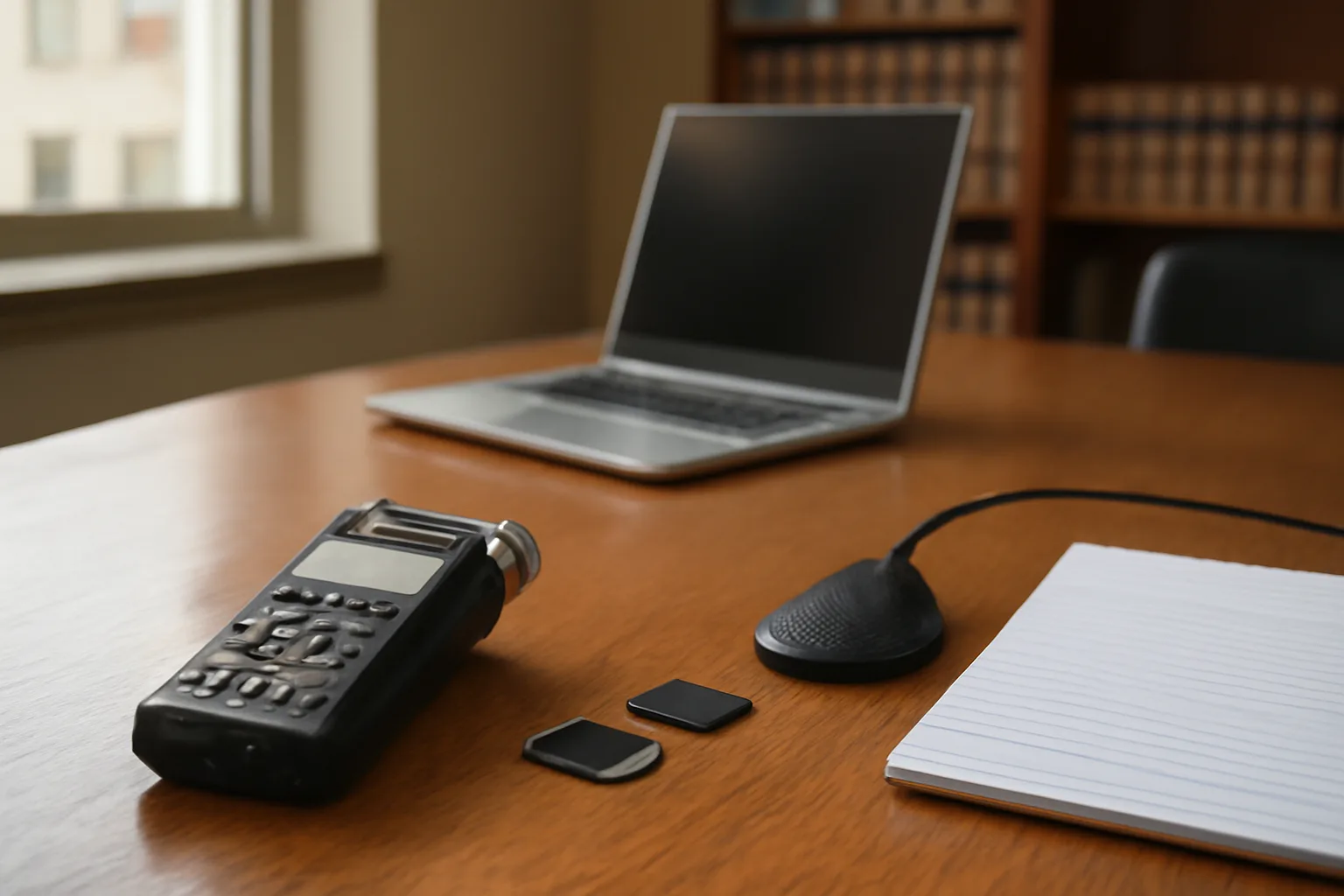
Equipment is the biggest swing. A reliable digital recorder runs $300 to $800. Add an external microphone ($100 to $200), a laptop you probably already own ($0 if you do, $800 to $1,200 if you don't), and transcription software ($0 to $300). Plenty of reporters start with one good handheld recorder and free Audacity, then upgrade once the checks come in.
The only upfront government fee is business registration. A Delaware LLC costs $90 [5]. You can run as a sole proprietor for nothing, but the LLC adds liability protection most reporters want.
Certification stacks on more. The AAERT Certified Electronic Reporter (CER) written and practical exams total $575 for non-members [4]. Training courses run from $199 for a targeted digital reporter kit to $2,000 or more for a full program.
Insurance is not required by the state. But court reporting firms and corporate clients often insist on general liability and errors and omissions coverage. A basic policy usually starts around $400 to $600 a year.
How long does it take to start as a digital court reporter in Delaware?
Three to four weeks is realistic. That covers ordering equipment, finishing a focused training course, registering your business, and lining up your first deposition.
No state waiting period exists. No license to approve, no apprenticeship to serve. The bottleneck is you. You need to be comfortable with the recorder, have a clean backup routine, and get a few practice transcripts done before someone pays you to be the official record.
Chasing AAERT certification adds a few weeks for exam scheduling and the practical evaluation. You can work while you pursue it.
What equipment do I actually need to start?
Four things get you working: a reliable digital recorder, an external microphone, a laptop, and playback software you trust.
Skip the voice memo app on your phone. A dedicated device like a Zoom H4n Pro or a Tascam DR-40X records uncompressed audio and writes to redundant media. A good lapel or boundary microphone catches testimony cleanly across a conference table. Your laptop needs enough power to move large audio files and run transcription software without choking. Free tools like Express Scribe or oTranscribe work fine, though many pros eventually pay for better playback controls.
Backup is not optional. Record to two SD cards at once, and push files to cloud storage the second the proceeding ends. One corrupted card with no backup is how you lose a client for good.
Do you need certification even without a state requirement?
No Delaware statute requires it. Attorneys often prefer it anyway. The AAERT Certified Electronic Reporter (CER) and Certified Deposition Reporter (CDR) are the most recognized national credentials for digital reporters, and both require written and practical exams covering equipment handling, annotation, ethics, and transcript production [8].
For someone new, a focused program that drills the exact skills the testing bodies want cuts the learning curve. The Digital CSR Path Kit, for example, is a $199 one-time resource covering recorder operation, marker placement, and real workflow, without a months-long classroom.
Is the $575 exam fee worth it? In a state with no license, a credential can set you apart when a firm compares candidates. It is not a legal prerequisite, and plenty of working digital reporters go years without it.
Can freelance digital court reporters work in Delaware courts?
Mostly no. The Court of Chancery, Superior Court, and Supreme Court all run their own digital audio recording systems. The Court of Chancery records proceedings digitally, and transcripts come from the court's own staff [2]. The Superior Court works the same way [3]. Freelancers are not hired for official sessions.
The work is elsewhere. Delaware has one of the busiest corporate litigation bars in the country, and every deposition in those cases is a proceeding where a freelance reporter gets hired directly by a firm or through an agency. The deposition market is your target. Not the courthouse.
How do I set up my business legally in Delaware?
Two clean paths. Run as a sole proprietor under your own name and Social Security number, with no state registration beyond any local business license your town requires. Or form a Delaware LLC, which separates your personal assets from business liabilities and is the usual pick for reporters.
LLC formation costs $90, paid to the Delaware Division of Corporations [5]. You file online through the state's One Stop portal [7]. Then get a federal Employer Identification Number from the IRS (free, online). If your county or city requires a business license, check locally. Wilmington, for one, requires a business license for any entity working within city limits.
Many digital reporters also get a Delaware notary commission. Title 29, Chapter 43 of the Delaware Code governs notaries and commissioning [6]. A notary stamp lets you swear in witnesses at depositions. The application goes through the Delaware Secretary of State and costs $107. Recording testimony does not legally require it, but having it removes a logistical headache that law firms notice.
How to find digital court reporter work in Delaware
Deposition work comes through two channels: direct relationships with law firms and subcontracting through national and regional agencies. The market centers on Wilmington, where corporate firms handle Chancery cases, patent fights, and complex commercial matters.
Build a list of Wilmington firms that take depositions often, then send a short email stating you are a digital court reporter available for depositions, with your equipment, turnaround times, and rates. Agencies that staff depositions across several states are often short on reporters willing to cover Delaware, so signing up with a few can fill your calendar fast.
Mid-Atlantic digital reporters typically charge $30 to $55 per hour for appearance time, plus per-page transcript fees. You set your own rates as an independent contractor, but you have to know what the local market pays.
A step-by-step checklist for starting today
1. Buy a professional-grade audio recorder and backup SD cards. 2. Finish a digital reporter training program or study the AAERT CER blueprint. 3. Register your business (LLC or sole proprietorship) with the Delaware Division of Corporations and the IRS. 4. Get a Delaware notary commission if you plan to swear witnesses. 5. Secure general liability and errors and omissions insurance. 6. Produce three practice transcripts and have an experienced reporter review them. 7. Contact Wilmington-area law firms and national reporting agencies with your availability.
Steps one through six fit inside four weeks. The Digital CSR Path's state resources include a Delaware market overview that speeds up step seven. With no license bottleneck, the timeline is yours to set.
Common mistakes to sidestep
The costliest mistake is buying gear without thinking about the room. A $100 recorder with built-in mics sitting ten feet from the witness produces garbage audio. Test your equipment in a real room before you go live.
Next one: no backup recorder. Run a single device, corrupt a file, and you have no record at all. That can end you in one afternoon.
Last, do not read "no license" as "no training needed." A transcript full of gaps, wrong speakers, or missing exhibits gets you blacklisted fast. Pay for real training, even the self-paced kind.
Frequently asked questions
Do you need a license for digital court reporter in Delaware?
No. Delaware has no state license for digital court reporters. No board, no mandatory exam, no application with any government agency. You can begin working as soon as your equipment and business structure are ready, which is usually a matter of weeks.
How much does digital court reporter cost in Delaware?
Startup runs $500 to $2,500. A recorder and microphone cost $400 to $1,000. Optional AAERT certification exams total $575 for non-members. A Delaware LLC costs $90, and a notary commission costs $107 if you want one. Insurance adds another $400 to $600 a year.
How long does digital court reporter take in Delaware?
With no licensing wait, most new reporters take deposition work within three to four weeks. That covers buying equipment, finishing a training course, registering a business, and marketing to firms. Pursuing AAERT certification can add several weeks for exam scheduling and the practical evaluation.
Does Delaware have a board of court reporters?
No. The Delaware Division of Professional Regulation lists every occupational licensing board, and court reporter is not among them [1]. The missing board confirms there is no state body that governs court reporters or digital court reporters in Delaware.
Is a notary commission required for digital court reporters in Delaware?
Not legally, but most digital reporters get a Delaware notary commission so they can swear in witnesses at depositions. The application fee is $107, and the Delaware Secretary of State handles the process under Title 29, Chapter 43 of the Delaware Code [6].
Can digital court reporters work in Delaware courts?
Freelancers are not used for official court proceedings. The Court of Chancery and Superior Court run internal digital recording systems and produce transcripts through court staff [2][3]. Freelance digital reporters work in the deposition setting for private law firms instead.
What certification is recognized for Delaware digital reporters?
AAERT's Certified Electronic Reporter (CER) and Certified Deposition Reporter (CDR) are the most recognized voluntary credentials [8]. Delaware requires no certification, but a national credential can help you compete for agency and law firm work in a market where nothing else distinguishes candidates on paper.
Where can I get digital court reporter training?
Several online programs teach the skills, from self-paced kits under $200 to full certificate programs over $2,000. Look for curricula covering recorder operation, annotation, exhibit handling, transcript formatting, and ethics. The AAERT website also lists exam preparation resources for the CER and CDR.
Do I need insurance as a digital reporter in Delaware?
The state does not require it. But reporting agencies and corporate clients frequently demand general liability and errors and omissions coverage. A basic policy usually costs $400 to $600 a year and protects you against negligence claims tied to transcript errors.
How do I find deposition work in Delaware?
Build a list of Wilmington corporate firms and contact them directly. Register with national agencies that staff depositions across the Mid-Atlantic. Many reporters start by taking overflow work from established agencies to build a reputation and a referral network before going after direct clients.
Can I work remotely as a Delaware digital court reporter?
Remote depositions are common and still growing. You can cover Delaware depositions from anywhere with reliable internet, quality remote recording software, and a way to handle virtual exhibits. Business registration and notary requirements still apply based on where the proceeding takes place in Delaware.
What are the continuing education requirements in Delaware?
Delaware has none, because no license exists. If you hold AAERT certification, you follow the association's recertification cycle instead, which typically requires continuing education credits every three years to keep the credential active.
Sources
- Delaware Division of Professional Regulation, Boards and Commissions: Delaware does not have a board of court reporters, confirming no state license requirement for digital court reporters.
- Delaware Court of Chancery, Transcripts: The Court of Chancery records proceedings digitally; freelance court reporters are not used for official court sessions.
- Delaware Superior Court, Transcripts: Superior Court proceedings are recorded internally, and the court does not contract with independent reporters.
- AAERT Certification: Non-member total exam fee for the AAERT CER written and practical exams is $575.
- Delaware Division of Corporations, Fee Schedule: The filing fee for a Delaware LLC Certificate of Formation is $90.
- Delaware Code, Title 29, Chapter 43, Notaries Public: Delaware law establishes notary commissioning; reporters often become notaries to administer oaths at depositions.
- Delaware One Stop, Business Registration: Businesses can register online through the One Stop portal; no occupational license is required for court reporters.
- AAERT Certified Electronic Reporter Requirements: AAERT certification requires passing a written and practical exam; not state-mandated in Delaware.